


HOW DO YOU PUSH A RIVER BACK TO ITS SOURCE? Text NININI? cohort2
Text Ni Ni Ni? 2026 offers an explorative creative process grounded in the intimacy of the diary form, we explore ‘text’ through a layered: practice-based, multi-perspective and transdisciplinary approach. This exploration is designed & co facilitated by Ogutu Muraya, Gloria Kiconco, and Mariam Ibrahim Boctor, under the guidance of Iraa - the Granary. The intention is to create a collective study experience - interweaving stories, memories, criticality, embodiment, sense perception, puzzlement, worlding and ludic learning. We therefore invite and convene a shared experience, as an attitude of interacting with each other that puts emphasis on the importance of playfulness, curiosity, and an openness to surprise.
In this process, the diary or if you like the journal is seen as a starting point - a living archive, a deep listener, a true companion. And by being in a collective process, the diary form has the space to evolve into a polyvocal experience with other voices. For this reason and to hold space for our togetherness, consent and confidentiality, are principal to our sharing sessions – everything is a negotiation and a dialogue, a deeper dive, where the map is not the territory and the diary is not necessarily just an ego document.
“That's the thing with a diary, though. In order to record your life, you sort of need to live it...Out in the world where it's so beautiful and
complex and painful that sometimes you just need to sit down and write about it.”
Diarist David Sedaris
‘How do you push a river back to its source?’ Is this year's provocation: the second book in a diary series. Book one framed the first provocation that came in 2024 – ‘How do you observe a stone that is about to strike you?’. This diary series is part of Ogutu Muraya’s long-term literary performance practice; an ongoing symbiosis between reading, writing and publishing as staging. The diary entries form a fragmented chronicle that evokes the crisis of imagination and the crisis of care, and the sincere quest for metamorphosis.
Who is at cohort 2

George Stanley Nsamba
FILM MAKER
I am George Stanley Nsamba, an award-winning Ugandan filmmaker, director, producer, screenwriter, and founder of The Ghetto Film Project. My belief in the power of storytelling for underserved communities has led me on a journey through the slums of Naguru in Kampala to the slums of Kibera, Nairobi, skilling young people together with Slum Film Festival, to Kisumu, Kenya with United In Film, Kano & Abuja in Nigeria, Petauke, Zambia to mention but a few. I tell stories about identity, resilience, mental health, human rights, and the everyday realities of our people. Through cinema, I strive to amplify voices that are often overlooked and inspire conversations that lead to meaningful change. My work as a filmmaker started in 2012. Since then, I have been on more than 50 sets for fiction and non - fiction narrative films across roles including director, cinematographer, first assistant director, and production crew. Beyond filmmaking, I am passionate about mentoring young creatives and using film as a tool for education, advocacy, and community transformation.


Gloria Kiconco
POET, WRITER & ARTIST
Gloria Kiconco is a Ugandan poet, non-fiction writer, and zine-artist. She has published poetry with PREE Lit Magazine, Transition Magazine, The Weganda Review, 20.35 Africa (2018) and Dear Nev: An Anthology of East African Writers. Her personal essays are published on Adda and More of Us. Gloria’s arts journalism features in People Stories Project, Dazed magazine, The Wire, Perform! And ART AFRICA. Gloria was one of the inaugural Writers-in-Residence (2019) with the Goethe Institut Burkina Faso, the first poet-in-residence with the Manchester Poetry Library (2023) and a 2024 Prince Claus Seed Awardee. Her zine collections include SOLD OUT (2016), RETURN TO SENDER (2018), You Are Lost, You Are Here X (2020), Tunnel of Delight (2021). Her exhibited works, in partnership with Borderlands Art, include Cardinal Directions (2024), Negative Space at the Atlanta Art Fair 2025 and her first solo exhibition, Poetics in Print (2026), at Latitude 0 in Kampala.

Trevor Aloka
ARTIST
Born 1997. Kampala, Uganda Aloka is a self-taught mixed media artist from Kampala, known for his innovative approach to storytelling. Through his interest in community, material exploration, spatial structures and experimentation, Aloka's work currently revolves around the themes of time, memory, documentation of day to day happenings and the exploration of various societal systems. He has participated in a number of group exhibitions and artist residencies locally and internationally and was recently awarded the Group A Absa L’ Atelier prize 2025.
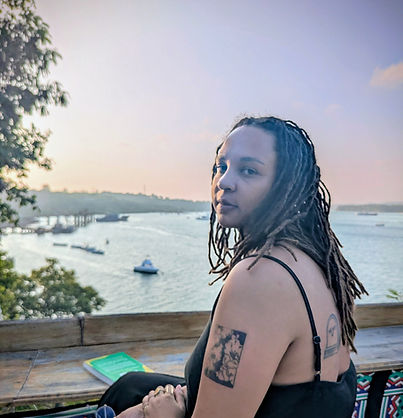
Sarah Bitamazire
POET, WRITER & VOCAL ARTIST
Sarah Bitamazire is a poet, writer and vocal artist with roots in Hoima, Uganda, and Hälsingland, Sweden, currently based in Malindi, Kenya. Her work moves between poetry, prose, and sound, layering the elements of the material world with the textures of human experience. She is at work on two parallel projects: a novel of critical fabulation researching her Bunyoro paternal lineage, working title Where Did Jajja Go?, and a poetry collection exploring grief, longing, and the magic of the mundane, working title I Was Always Water. Her writing also appears on her Substack, She writes on petals & poetry, and is currently working on two parallel projects: a poetry collection, I Was Always Water, and a novel researching Bunyoro history through her paternal lineage, working title "Where did Jajja go?" Her creative work spans editorial writing (OFF TO Magazine, Uttryck Magazine), performance and collaboration (The Last Lost Baobabs, Tales & Tides Collective, Kinshasa Poetry Society), and songwriting, including the track "Rain," performed by Celine Banza. She has served as a policy advisor and political advisor in the Swedish Parliament, and currently works as Senior Operations Associate at the Africa E-Mobility Alliance, where her role is legal counsel and operations. She also does operations work for artist collectives.

Kajebe Jacob Joshua
CURATOR, ARTIST, RESEARCHER
Kajebe Jacob Joshua (born 1996) is a Ugandan interdisciplinary artist, curator, and researcher based in Kampala. Working across mixed-media printmaking, barkcloth, textiles,installation, and socially engaged practice. He explores the intersections of cultural memory, material heritage, and everyday rituals. His work investigates how indigenous making traditions can respond to contemporary social challenges, particularly those surrounding mental health, identity, belonging, and collective wellbeing. Kajebe has exhibited in Uganda, Norway, and Russia, with presentations at Bergen Kjøtt, the Faculty of Art, Music and Design (KMD), University of Bergen, Makerere University, and Afropocene (The Capsule). His practice has been enriched through collaborations with the British Council Art Exchange: Moving Image programme, Makerere University, Xenson Art Space, Afriart Gallery, GZK, and the Njabala Foundation. He is the Co-Founder of Muundo Foundation, an initiative that uses art to foster dialogue, learning, and community engagement. Kajebe holds a Bachelors degree in Industrial and Fine Arts from Makerere University and is currently completing a Master’s degree in Fine Art.

Sarafina Kebirungi aka Kengi
INTER-DISPLINERY ARTIST & RESEARCHER
Sarafina Kebirungi aka Kengi is an interdisciplinary artist working across fibre, textiles, sculpture, and installation. Her research-led practice explores the relationships between nature, traditional craft, and ecological knowledge. Born in a region enriched by the Rwenzori Mountains, diverse wildlife and rich ecosystems, her work is deeply inspired by natural forms, patterns, and interspecies connections. With a Bachelor's degree in Art and Industrial Design, specialising in textiles and fabric decoration, she combines weaving, macramé, basketry, embroidery, crochet, and experimental fibre techniques with material research. Through material research and experimental making, she creates thoughtful connections between inherited knowledge, contemporary art, and the living world.

Mariam Ibrahim Boctor
CURATOR
Mariam Boctor is a part time cat and full time nerd based in Egypt. Their work traverses healthcare, theater and storytelling, contemporary art, journalism, and translation.Their words have been published by The Outpost, Mada Masr, Arab Lit and the Contemporary Image Collective. They were part of the curatorial team that produced exhibitions and public programming for Botoun and a Lifetime of Wind at the Contemporary Image Collective in Cairo, 2019-2021, including reading groups, writing workshops and publications including: The Recipe, The Taste of Letters, and Our Bodies Breathe Underwater. As part of Kusbarra Collective they have co-produced various workshops and events on food, care, labour and grief including their ongoing project Mukawen- an ode to hosting, cooking and collaborative practices. They were part of the Àsìkò Art School 2025 cohort in Cairo on Holding Memory; they co-produced the sonic meditation Letmeteachyouhowtoswim in collaboration with Khanyisile Mbongwa for the Transnational Ecological Grief Council. In 2026 they published the sonic tale “Bird Tongue Soup” as part of The ECCO. They are a student-practitioner of Traditional Chinese Energetics.

Ogwado Joachim
ARTIST
Ogwado is a Ugandan-based artist whose practice is rooted in play, using childhood memory as a way to engage the present and connect with the world through a visual language. Working across sculpture, painting, and installation, he explores collective consciousness through found objects, with a focus on reclaiming and reimagining single-use plastics. Drawing on traditional craftsmanship such as weaving, stitching, and assemblage, he transforms discarded materials into narratives that speak to nostalgia, material politics, environmental stewardship, and community resourcefulness. Collaboration and community engagement are central to his practice, creating spaces for shared learning, dialogue, and collective ownership. Ogwado challenges perceptions of plastic by highlighting its creative and social potential. He exhibited in "Surfaces" at Afriart Gallery (2024), received the 2023 Innovation Award from the International Sculpture Center, completed a residency at 32° East, and holds a BA in Art and Industrial Design from Kyambogo University.

Ogutu Muraya
THEATER MAKER, STORY TELLER, WRITER
Ogutu Muraya is a theater maker, storyteller and writer. His work investigates orality and literature, and the emancipatory and imaginative potential of personal narrative. He explores new forms of storytelling with a profound curiosity in the connection between the spiritual and the neurological, between realms of thinking and meaning, change and understanding. His recent book - ‘How do you observe a stone that is about to strike you?’ explores the practice of diarizing while sharing with readers his diasporic experiences living and studying in Amsterdam. His performative works and storytelling have featured in several theatres and festivals including- La Mama (NYC), The Hay Festival (Wales), HIFA (Harare), SICK Festival (Manchester), Ranga Shankara (Bangalore), Afrovibes Festival (Amsterdam), Spielart (Munich), Theater Spektakel (Zurich), Festival Theaterformen (Braunschweig), Theatre is Must Forum (Alexandria), Theatre Commons (Tokyo) & within East Africa. Ogutu is based in Malindi, Kenya where he continues his artistic practice and also works with Maabara - a performance, practice-oriented collaborative laboratory for artistic research and work processes.
.png)
Gorreth Nagganja
CULTURAL PRACTIONER
Gorreth Nagganja is a cultural practitioner based in Kampala, Uganda. She critically engages themes of erasure of endemic traditions of Uganda through examining documented histories, cultural memory and analysis of processes of cultural transformation. Through critical writing and performance as artistic research, she engages audiences in reflective encounters to examine contemporary identity. She has written for Andariya Magazine (2026) and previously published exhibition reviews with The Independent (2025). Her inaugural exhibition, Ku Lujjuliro (2026), showcased the largely disappearing, ancient floor-dining practice of the Baganda people through installation and re-performance.

Sandra Suubi
ARTIVIST & VOCALIST
Sandra Suubi (b. 1990) is an Ugandan artivist and vocalist living and working between Wakiso and Kampala. She holds a Master of Fine Arts from Makerere University. Her practice treats the human body and gallery spaces as dual sites of historical and environmental advocacy, transforming discarded plastic waste through labor-intensive performance installations and music. Suubi’s work addresses climate policy, memory, and colonial legacies. Notable projects include the Samba Gown at the 2023 Liverpool Biennial and presentations at Climate Story Lab Africa. Incorporating musical compositions like KIRAGALA, her artivism connects visual and sonic environments to provoke socio-political awakenings. Recognized with the Mukumbya Musoke Art Prize (2022–2024) and international residencies in Senegal, Kenya, and the Netherlands, Suubi fosters community dialogues through experimental initiatives like Iraa The Granary and BUUKA Art Space in Wakiso, challenging audiences to confront shared environmental responsibilities.

Immy Mali
ARTIST
Immy Mali lives and works in Kampala Uganda. Using a variety of media including, text, drawing, video, sound, sculpture, animation, her work attempts to unpack the complexities and entanglements of memory as well as virtuality of the self and the other. Notions of presence and absence, juxtaposed with personal and collective experiences of existence in shifting spaces also influence her work. The project Letters to my childhood (2017-2021) accords her the duality to engage with her past and present simultaneously. Together with her sister, they co-founded Iraa-the granary an experimental artist’s kitchen geared towards exploring the building of archival/memory systems of artists’ practices in ways that are relevant to the Ugandan/ East African context. In 2013, she obtained her BA in Industrial and Fine Arts from Margaret Trowell School of Industrial and Fine arts, Makerere University, Kampala. She is an alumnus of the Rijksakademie van Beeldende Kunsten in Amsterdam, Netherlands (2018-2019) , The Asiko art school 2015 and has participated in exhibitions, residencies and workshops online and in various countries including Kenya, Netherlands, India, Ethiopia, Denmark, Germany, USA, South Africa, Mozambique, Angola, and Uganda. Her work has been published in art magazines including the Africa arts journal 2019. She is currently a Prince Claus Carec cycle 5 Fellowship Awardee for the year 2026